
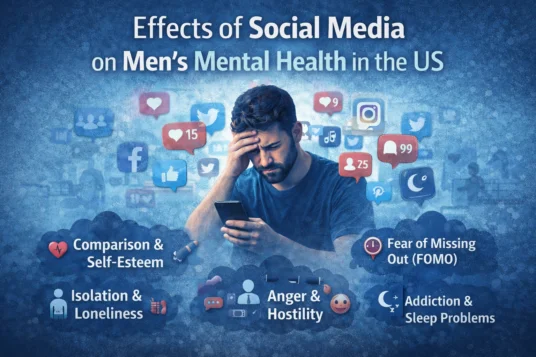
The Hidden Costs: Effects of Social Media on Men’s Mental Health in the US
For decades, traditional media portrayed a narrow, often stoic, version of masculinity. Social media, while seemingly offering a broader platform, has paradoxically amplified new pressures—from the ‘perfect’ physique to the ‘hustle porn’ of endless productivity. This isn’t just about fleeting moments of envy; it’s about a systemic shift that can erode self-worth, foster isolation, and fuel a silent crisis of mental well-being among American men.
1. The Comparison Trap: A Constant Scoreboard of Success
Every scroll through platforms like Instagram or LinkedIn can feel like a direct comparison to others’ curated highlight reels. For men, this often manifests as pressure to achieve an idealized version of success, both professionally and personally. You see peers flaunting new cars, exotic vacations, or rapid career advancements, and subconsciously, a question arises: “Am I doing enough?”
This constant benchmarking, fueled by carefully filtered images and exaggerated narratives, can trigger feelings of inadequacy, resentment, and even depression. It’s not just about wealth; it’s about physical appearance, relationship status, and even perceived “happiness.” The **effects of social media on men’s mental health in the US** often begin with this insidious comparison, where reality is pitted against an unattainable digital ideal.
“Comparison is the thief of joy.” — Theodore Roosevelt
2. Body Image Pressure: The New Masculine Ideal
While historically associated more with women, body image issues are a rapidly growing concern for men, heavily influenced by social media. Platforms are saturated with images of impossibly muscular, lean physiques, often enhanced by filters or even steroids.
This creates an intense pressure for men to achieve a certain body type, leading to:
- Muscle Dysmorphia: A disorder where individuals believe their body is not muscular enough, even when they are.
- Unhealthy Eating Patterns: Extreme dieting, excessive supplement use, or disordered eating in pursuit of an ‘ideal’ physique.
- Anxiety and Depression: Directly linked to dissatisfaction with one’s physical appearance.
The pursuit of this often-unrealistic ideal, heavily promoted through fitness influencers and aspirational posts, is a significant contributor to the negative **effects of social media on men’s mental health in the US**.
Internal Link: Explore our guide on balanced nutrition for male well-being.
3. The Illusion of Connection & Real Isolation
Social media promises connection, but often delivers a superficial substitute. While you might have hundreds of “friends” online, the depth of these relationships is often lacking. For men, who are already culturally conditioned to suppress vulnerability and emotions, social media can exacerbate real-world isolation.
| Social Media Aspect | Impact on Men’s Mental Health | Real-World Antidote |
|---|---|---|
| Curated Feeds | Increased feelings of inadequacy, FOMO (Fear Of Missing Out) | In-person hangouts, shared hobbies |
| Online Interactions | Superficial connections, reduced deep empathy | Direct conversations, active listening |
| “Performance” Pressure | Anxiety about personal brand, constant self-editing | Authenticity, shared vulnerabilities with trusted friends |
| Cyberbullying/Trolling | Emotional distress, self-doubt (even if ignored) | Setting boundaries, blocking toxic accounts |
Spending hours passively scrolling can replace meaningful face-to-face interactions, leading to a profound sense of loneliness. This is a critical factor in understanding the **effects of social media on men’s mental health in the US**, as genuine connection is a cornerstone of human well-being.
4. Sleep Disruption and Cognitive Overload
The blue light emitted from screens suppresses melatonin production, making it harder to fall asleep. For working men in the US, who are often already battling demanding schedules, this can lead to chronic sleep deprivation. Poor sleep is a direct pathway to increased anxiety, irritability, and impaired cognitive function.
Moreover, the constant influx of information—news, notifications, updates—creates a state of cognitive overload. Our brains were not designed to process such vast amounts of data without breaks. This can lead to:
- Difficulty concentrating at work.
- Increased mental fatigue.
- A persistent feeling of being “on edge.”
The cycle of late-night scrolling and subsequent poor sleep is a vicious one, significantly impacting the overall **effects of social media on men’s mental health in the US**.
5. The Echo Chamber and Political Polarization
Social media algorithms often create “echo chambers,” where individuals are primarily exposed to information that confirms their existing beliefs. While this might seem comforting, it can lead to:
- Increased Anger and Frustration: Constant exposure to opposing viewpoints framed as “enemy” narratives.
- Reduced Empathy: Less exposure to diverse perspectives makes it harder to understand or relate to others.
- Heightened Anxiety: A pervasive sense of societal division and conflict.
For men, who are often encouraged to be “strong” and “unwavering,” the intensity of online political discourse can fuel a sense of constant battle, taking a heavy toll on their mental peace. This unseen aspect is a powerful driver of the negative **effects of social media on men’s mental health in the US**.
External Link: Read more on Pew Research Center’s findings on social media and polarization.
Top 10 FAQs: Social Media & Men’s Mental Health in the US
1. What is “doomscrolling” and how does it affect men?
Doomscrolling is compulsively consuming negative news and content. For men, it can amplify feelings of helplessness, anxiety, and a skewed perception of reality, making the world seem worse than it is.
2. Does social media contribute to anger issues in men?
Yes. Online anonymity and echo chambers can encourage aggressive communication, leading to increased real-world irritability and difficulty managing anger, especially when confronted with differing opinions.
3. How can I tell if social media is negatively affecting my mental health?
Signs include increased anxiety after scrolling, constant comparison, feeling restless, difficulty concentrating, sleep problems, or reduced desire for in-person social interaction.
4. What is “Fear Of Missing Out” (FOMO) and how does it relate to men?
FOMO is anxiety that an exciting or interesting event may currently be happening elsewhere. For men, seeing others’ successes or social gatherings online can trigger feelings of inadequacy or being left out.
5. Should I completely delete my social media accounts?
Not necessarily. A “digital detox” or mindful usage can be more sustainable. Identify which platforms cause distress and consider limiting or unfollowing triggering accounts, rather than a full deletion.
6. Are there specific platforms that are worse for men’s mental health?
Platforms heavily focused on visual aesthetics (Instagram, TikTok) can exacerbate body image issues. News-heavy platforms (Twitter, Facebook) can fuel anxiety and political polarization.
7. How can I use social media more positively?
Follow accounts that inspire, educate, or entertain without comparison. Engage in meaningful conversations, share genuine updates, and use it as a tool, not a constant distraction.
8. Does social media affect self-esteem in young men?
Absolutely. The pressure to conform to unrealistic standards of looks, wealth, and popularity can severely impact self-esteem during formative years, leading to long-term issues.
9. How can I set boundaries with social media for better mental health?
Implement “no-phone zones” (bedroom, dinner table), schedule specific times for social media checks, use app timers, and turn off notifications.
10. What role does social media play in loneliness for men?
It creates an illusion of connection that often replaces genuine, in-person interactions. This superficiality can lead to a deeper sense of isolation and loneliness, despite having many “online friends.”
Reclaiming Your Digital Well-being: Strategies for Men in the US
Understanding the effects of social media on men’s mental health in the US is the first step toward reclaiming your peace. It’s not about demonizing technology, but about becoming a conscious consumer rather than a passive recipient. Here are actionable strategies:
- Mindful Consumption: Ask yourself: “Does this post make me feel better or worse?” Unfollow or mute accounts that consistently trigger negative emotions.
- Scheduled Breaks: Designate specific times of the day to check social media and stick to them. Avoid late-night scrolling.
- Cultivate Real Connections: Prioritize face-to-face interactions, phone calls, or video chats with close friends and family over endless scrolling.
- Engage in Analog Hobbies: Reconnect with activities that provide a “flow state”—reading, sports, hiking, cooking, woodworking. These are natural dopamine boosters without the digital burnout.
- Digital-Free Zones: Make your bedroom and dining area sacred spaces, free from screens. This improves sleep and fosters genuine interaction.
- Practice Self-Compassion: Remember that everyone’s online persona is a highlight reel. Be kind to yourself and recognize your own worth, independent of online validation.
Conclusion: A Conscious Choice for a Calmer Mind
The digital landscape is here to stay, but how we navigate it is entirely within our control. For men in the US, acknowledging the subtle yet profound **effects of social media on men’s mental health in the US** is vital. By making conscious choices about our online engagement, we can move from a state of constant reaction to one of thoughtful interaction. This journey isn’t just about reducing screen time; it’s about investing in a more resilient, authentic, and mentally healthier version of yourself.
Ready to build a healthier digital life? Explore our Digital Wellness Toolkit for more resources and practical guides.
HeroUP is a premium mens wellness formula designed to support sustained energy, physical stamina, and everyday confidence.
Mitolyn is a carefully developed, plant-based formula created to help support metabolic efficiency and encourage healthy, lasting weight management.
Gluco6 is a natural, plant-based supplement designed to help maintain healthy blood sugar levels.
InsuLeaf is a high-quality, naturally formulated supplement created to help maintain balanced blood glucose, support metabolic health, and boost overall vitality.
Manergy is an advanced male vitality supplement created to help support healthy testosterone levels
NerveGenics is a naturally formulated nerve-health supplement created to promote nerve comfort, cellular energy support, antioxidant defense
ProstAfense is a premium, doctor-crafted supplement formulated to maintain optimal prostate function, enhance urinary performance, and support overall male wellness.
The bodys natural process of skin cell renewal is essential for preserving a smooth, healthy, and youthful-looking complexion.
Nitric Boost Ultra is a daily wellness formula designed to enhance vitality and help support all-around performance.
Visium Pro is an advanced vision support formula created to help maintain eye health, sharpen visual performance, and provide daily support against modern challenges such as screen exposure and visual fatigue.
ViriFlow is a dietary supplement formulated to help maintain prostate, bladder, and male reproductive health. Its blend of plant-based ingredients is designed to support urinary comfort and overall wellness as men age.