Suicide Rates Among Men in the United States 2026: Causes & Prevention
In 2026, the United States faces one of its most daunting public health challenges: a persistent and tragic rise in male suicide. Despite technological breakthroughs and increased awareness, the numbers tell a story of a “silent epidemic.” Understanding suicide rates among men in the United States 2026 is not just about analyzing spreadsheets; it’s about recognizing the human faces behind the data—our fathers, brothers, sons, and friends.This comprehensive guide explores the multi-layered causes of this crisis, from economic shifts to cultural stigmas, and outlines the vital prevention strategies that are making a difference in the current year.
The 2026 Statistical Landscape: A Closer Look
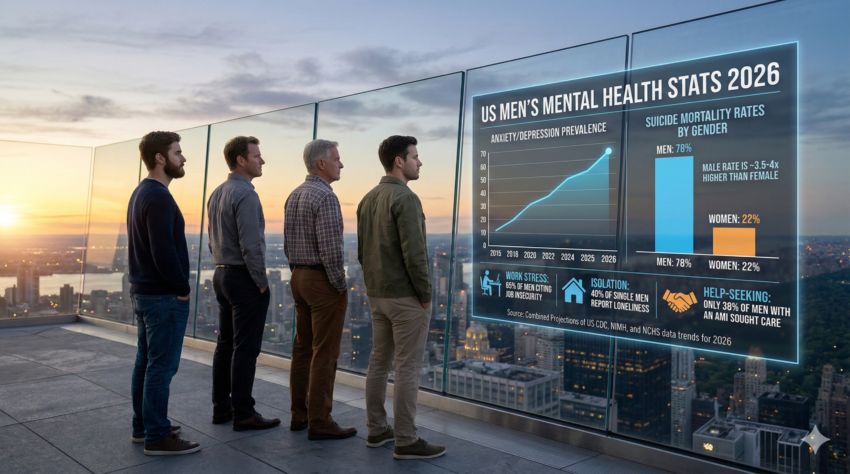
As we analyze the data for 2026, the disparity between genders remains stark. While women are more likely to attempt suicide, men are nearly four times more likely to die by it. This is often referred to as the “Gender Paradox” in mental health.
Key 2026 Data Points
Total Percentage: Men account for approximately 78% of all suicide deaths in the US.
Age Demographic: Men over the age of 75 and young adults between 18-25 show the sharpest increases this year.
Geographic Trends: Rural states in the Mountain West continue to show higher rates compared to urban coastal areas, largely due to isolation and limited access to care.
Age Group (Men)
2026 Est. Rate (per 100k)
Primary Stressor
18 – 25
24.5
Social Isolation & Academic Pressure
35 – 54
28.2
Financial Instability & Family Stress
75+
42.1
Chronic Illness & Loneliness
Root Causes: Why 2026 is Different
The factors contributing to suicide rates among men in the United States 2026 are deep-rooted and evolving. We cannot look at 2026 without acknowledging the rapid changes in society.
1. The Identity Crisis in the AI Era
As AI continues to reshape the American workforce, many traditional “provider” roles in manufacturing and logistics have been displaced. For many American men, their job is their identity. When that is lost, a profound sense of purposelessness sets in.
As artificial intelligence continues to redefine industries across the United States, traditional male-dominated roles in manufacturing, logistics, and manual operations are rapidly evolving or disappearing. For decades, many American men have tied their self-worth and identity closely to their profession — seeing themselves as providers, protectors, and problem-solvers. However, with AI automation replacing routine labor and restructuring workplace demands, this long-standing connection between job and identity is being challenged like never before.
When employment stability weakens or career paths become uncertain, it often triggers more than financial stress — it sparks a deep emotional vacuum. Many men begin to question their purpose, value, and relevance in a rapidly changing economy. This silent internal struggle can manifest as anxiety, withdrawal, or even resentment toward technological change.
The transition toward AI-driven productivity does not only demand skill upgrades; it demands psychological adaptation. Without proper emotional support systems, men navigating job displacement or career transformation may experience a crisis of identity. The loss of a role they once defined themselves by can lead to reduced confidence, increased stress, and a sense of invisibility within society.
In 2026, mental health conversations must expand beyond traditional stressors and acknowledge the emotional impact of technological disruption. Helping men rebuild purpose through reskilling, community belonging, and redefining success beyond employment is becoming essential for long-term psychological resilience in the AI era.
2. Social Isolation and “The Loneliness Epidemic”
Despite being digitally connected, 2026 has seen a decline in “third places”—physical spaces like community centers, clubs, and local gathering spots. For men, who often bond through shared activities, this loss of community is devastating.
Even though men today are more digitally connected than ever before, real-world human interaction is steadily declining across the United States. In 2026, the disappearance of “third places” — such as community centers, sports clubs, hobby groups, and local hangouts — has significantly reduced opportunities for organic social bonding. Traditionally, men often formed emotional connections through shared activities rather than direct conversations. Whether it was playing sports, working on projects, or simply gathering in local spaces, these environments provided silent emotional support systems.
With these physical spaces fading due to urban lifestyle changes, remote work culture, and digital entertainment dominance, many men now find themselves socially disconnected despite being constantly online. Virtual interactions rarely replace the depth of real-world camaraderie. Over time, this lack of meaningful connection contributes to loneliness, emotional detachment, and reduced mental resilience.
The modern loneliness epidemic is not always visible. Men may appear socially active on digital platforms while internally feeling isolated and unsupported. Without structured spaces to engage in shared purpose or routine interaction, emotional isolation grows silently. Rebuilding community through intentional social environments, group activities, and shared experiences is becoming crucial to protecting men’s mental health in the evolving social landscape of 2026.
3. Substance Abuse and “Deaths of Despair”
The opioid crisis, though managed better than in previous years, still casts a long shadow. Alcohol-related deaths and substance abuse are often precursors to suicidal ideation among men who use these as “numbing agents” for emotional pain.
Although the opioid crisis in the United States is being addressed more proactively in 2026, its psychological aftermath continues to impact men’s mental health in profound ways. Substance use — including alcohol, prescription misuse, and recreational drugs — often becomes a coping mechanism for men who struggle to express emotional distress. Instead of seeking help, many turn to these substances as temporary “numbing agents” to silence anxiety, grief, financial stress, or identity struggles.
This pattern is closely linked to what experts describe as “Deaths of Despair” — fatalities connected to substance abuse, alcohol-related illnesses, and suicide. For many men, substance dependency begins as an attempt to manage internal pain but gradually deepens emotional instability. Alcohol misuse in particular is strongly associated with impulsivity and increased suicidal ideation.
Over time, reliance on substances not only masks emotional suffering but intensifies feelings of hopelessness and isolation. The cycle becomes self-reinforcing: emotional pain leads to substance use, which in turn worsens mental health outcomes. Breaking this pattern requires not just addiction treatment but also addressing the underlying emotional struggles that often remain hidden beneath the surface.
In 2026, recognizing substance use as a mental health signal rather than merely a behavioral issue is essential. Preventative support systems, early emotional intervention, and accessible recovery pathways can play a key role in reducing long-term psychological harm and protecting men from the escalating risks associated with despair-driven coping mechanisms.
Prevention Strategies: Moving from Awareness to Action
If we want to lower the suicide rates among men in the United States 2026, our approach must be as diverse as the causes. Prevention in 2026 is becoming more personalized and proactive.
The Role of Technology & AI in Prevention
2026 has introduced AI-driven “Early Warning Systems.” Wearable tech can now track physiological markers of acute stress—like cortisol spikes or irregular heart rhythms—and prompt the user to engage with a crisis counselor immediately.
Community-Based Interventions
Programs like “Men’s Sheds” and “Peer-to-Peer Support Networks” are proving that men are more likely to talk when they are working on a project or engaged in a hobby. Moving the conversation from a clinical office to a community setting is saving lives.
Overcoming the Stigma of “Manhood”
The “Strong Silent Type” myth is perhaps the biggest barrier to prevention. In 2026, we are seeing a cultural shift where prominent American athletes and leaders are openly discussing their struggles. This “Permission to be Human” is essential for men to seek help before they reach a crisis point.
Frequently Asked Questions (FAQ)
1. How does social media affect men’s mental health?
Social media can increase stress, comparison, loneliness, and anxiety in men by creating unrealistic expectations and constant digital pressure.
2. Why are men more affected by social media stress?
Many men hesitate to express emotions openly, so they internalize pressure from online comparison and social validation.
3. Can social media cause depression in men?
Excessive social media use can contribute to depressive symptoms by increasing feelings of inadequacy and isolation.
4. Does social media increase anxiety in working men?
Yes, workplace comparison and productivity pressure often get amplified through professional networking platforms.
5. How does social media impact self-esteem in men?
Constant exposure to ideal lifestyles and success stories can negatively impact self-worth.
6. Can social media affect sleep patterns?
Late-night scrolling disrupts sleep cycles and increases mental fatigue.
7. Does social media increase loneliness?
Despite being connected online, men often feel emotionally disconnected in real life.
8. Is social media linked to anger or frustration?
Online criticism and comparison can trigger irritability and emotional instability.
9. How much social media usage is considered unhealthy?
Spending more than 2-3 hours daily on non-essential scrolling may start affecting mental wellbeing.
10. Can reducing social media improve mental health?
Yes, limiting usage often leads to better mood, improved focus, and reduced stress.
In the US, 988 is the universal three-digit dialing code for the Suicide & Crisis Lifeline. It provides 24/7, free, and confidential support for people in distress.
12. How can I help a friend who is struggling?
Ask directly. Research shows that asking someone “Are you thinking about suicide?” does not “put the idea in their head”; rather, it often provides an immense sense of relief that someone noticed.
12 thoughts on “Suicide Rates Among Men in the United States 2026”
**heroup**
HeroUP is a premium mens wellness formula designed to support sustained energy, physical stamina, and everyday confidence.
InsuLeaf is a high-quality, naturally formulated supplement created to help maintain balanced blood glucose, support metabolic health, and boost overall vitality.
InsuLeaf is a high-quality, naturally formulated supplement created to help maintain balanced blood glucose, support metabolic health, and boost overall vitality.
Hello supporters of fresher indoor environments !
Finally, consider professional reviews and comparisons when looking for the best air purifiers for allergies. Websites dedicated to consumer advice often provide comprehensive assessments to guide your choices. <a href="https://best-air-purifiers-for-allergies.vercel.app/#" rel="best-air-purifiers-for-allergies.vercel.app. With thorough research, you can confidently select the ideal air purifier for your allergy relief.
The air in your home can harbor numerous allergens, making purification a necessity. Relying on best-air-purifiers-for-allergies.vercel.app will ensure you select an air purifier that addresses your specific concerns. Make healthier choices for your home environment today.
The Best Air Purifiers for Allergies: Essential for Every Home – http://best-air-purifiers-for-allergies.vercel.app/#
May you enjoy incredible pollen-free air discoveries !
Backbiome is an advanced daily wellness supplement formulated to help support spinal comfort, reduce feelings of built-up tension, and promote freer, smoother movement throughout everyday life.
Contains information related to marketing campaigns of the user. These are shared with Google AdWords / Google Ads when the Google Ads and Google Analytics accounts are linked together.
90 days
__utma
ID used to identify users and sessions
2 years after last activity
__utmt
Used to monitor number of Google Analytics server requests
10 minutes
__utmb
Used to distinguish new sessions and visits. This cookie is set when the GA.js javascript library is loaded and there is no existing __utmb cookie. The cookie is updated every time data is sent to the Google Analytics server.
30 minutes after last activity
__utmc
Used only with old Urchin versions of Google Analytics and not with GA.js. Was used to distinguish between new sessions and visits at the end of a session.
End of session (browser)
__utmz
Contains information about the traffic source or campaign that directed user to the website. The cookie is set when the GA.js javascript is loaded and updated when data is sent to the Google Anaytics server
6 months after last activity
__utmv
Contains custom information set by the web developer via the _setCustomVar method in Google Analytics. This cookie is updated every time new data is sent to the Google Analytics server.
2 years after last activity
__utmx
Used to determine whether a user is included in an A / B or Multivariate test.
18 months
_ga
ID used to identify users
2 years
_gali
Used by Google Analytics to determine which links on a page are being clicked
30 seconds
_ga_
ID used to identify users
2 years
_gid
ID used to identify users for 24 hours after last activity
24 hours
_gat
Used to monitor number of Google Analytics server requests when using Google Tag Manager


**heroup**
HeroUP is a premium mens wellness formula designed to support sustained energy, physical stamina, and everyday confidence.
**prime biome**
The bodys natural process of skin cell renewal is essential for preserving a smooth, healthy, and youthful-looking complexion.
**insuleaf**
InsuLeaf is a high-quality, naturally formulated supplement created to help maintain balanced blood glucose, support metabolic health, and boost overall vitality.
InsuLeaf is a high-quality, naturally formulated supplement created to help maintain balanced blood glucose, support metabolic health, and boost overall vitality.
The bodys natural process of skin cell renewal is essential for preserving a smooth, healthy, and youthful-looking complexion.
HeroUP is a premium mens wellness formula designed to support sustained energy, physical stamina, and everyday confidence.
Hello supporters of fresher indoor environments !
Finally, consider professional reviews and comparisons when looking for the best air purifiers for allergies. Websites dedicated to consumer advice often provide comprehensive assessments to guide your choices. <a href="https://best-air-purifiers-for-allergies.vercel.app/#" rel="best-air-purifiers-for-allergies.vercel.app. With thorough research, you can confidently select the ideal air purifier for your allergy relief.
The air in your home can harbor numerous allergens, making purification a necessity. Relying on best-air-purifiers-for-allergies.vercel.app will ensure you select an air purifier that addresses your specific concerns. Make healthier choices for your home environment today.
The Best Air Purifiers for Allergies: Essential for Every Home – http://best-air-purifiers-for-allergies.vercel.app/#
May you enjoy incredible pollen-free air discoveries !
ProDentim is a modern oral-health supplement formulated with specialized probiotics and naturally sourced ingredients to help maintain firm teeth
NerveCalm is a high-quality nutritional supplement crafted to promote nerve wellness, ease chronic discomfort, and boost everyday vitality.
Backbiome is an advanced daily wellness supplement formulated to help support spinal comfort, reduce feelings of built-up tension, and promote freer, smoother movement throughout everyday life.
AquaSculpt is a high-quality metabolic support supplement created to help the body utilize fat more efficiently while maintaining steady
GL Pro is a natural dietary supplement formulated to help maintain steady, healthy blood sugar levels while easing persistent sugar cravings.