

Signs of Emotional Burnout in Long-Term Dating: The 2026 Ultimate Survival Guide
Love is supposed to be a sanctuary, but for many in 2026, it has become another “task” on an overstuffed to-do list. Emotional burnout in long-term dating isn’t just about being tired; it’s a profound state of emotional depletion where the spark hasn’t just flickered—it feels like the oxygen has left the room.
In this deep-dive guide, we explore why even the strongest couples hit a wall and how to distinguish between a “rough patch” and a “burned-out soul.”
Understanding the Core: What is Emotional Burnout in Relationships?
Unlike a sudden breakup, emotional burnout is a slow erosion. It is often the result of prolonged “emotional labor” without adequate “emotional replenishment.” In the context of psychological health, it mirrors workplace burnout but with higher stakes because it involves your primary support system.
The Psychological Mechanism
When you are constantly navigating your partner’s moods, managing household logistics, or walking on eggshells to avoid conflict, your brain’s amygdala stays in a state of high alert. Over time, your empathy reserves run dry.
—
Major Signs of Emotional Burnout in Long-Term Dating
1. Persistent Emotional Numbness
You no longer feel the highs of a date night or the lows of an argument. You feel “flat.” This emotional detachment is a defense mechanism your brain uses to protect you from further stress.
2. Dread Over Interaction
Do you stay in your car for an extra ten minutes after work just to delay seeing your partner? This dread is a hallmark sign that the relationship has become a source of drainage rather than energy.
3. Increased Irritability over Minor Issues
The way they chew, the way they breathe, or their choice of shoes suddenly feels like a personal affront. When you’re burned out, your “tolerance window” shrinks to zero.
—
Research Data: Dating & Burnout Trends in the USA (2025-2026)
Recent studies in 2026 indicate that the intersection of economic stress and “digital saturation” has increased relationship burnout rates by 22% compared to the previous decade.
| Category of Stressor | Impact Percentage (USA) | Primary Symptom Reported |
|---|---|---|
| Digital Fatigue (Social Media Comparison) | 34% | Inadequacy & Resentment |
| Financial Co-dependency | 28% | Trapped Feeling/Anxiety |
| Unequal Emotional Labor | 41% | Chronic Exhaustion |
| Lack of “Me-Time” | 19% | Loss of Identity |
—
How to Differentiate Burnout from “Falling Out of Love”
It’s easy to confuse the two. However, there is a distinct difference:
- Falling out of Love: The desire to be with the person is gone. You don’t see a future, and you don’t care to fix it.
- Emotional Burnout: You still love them, but you cannot do the work anymore. You want to want them, but your “battery” is at 0%.
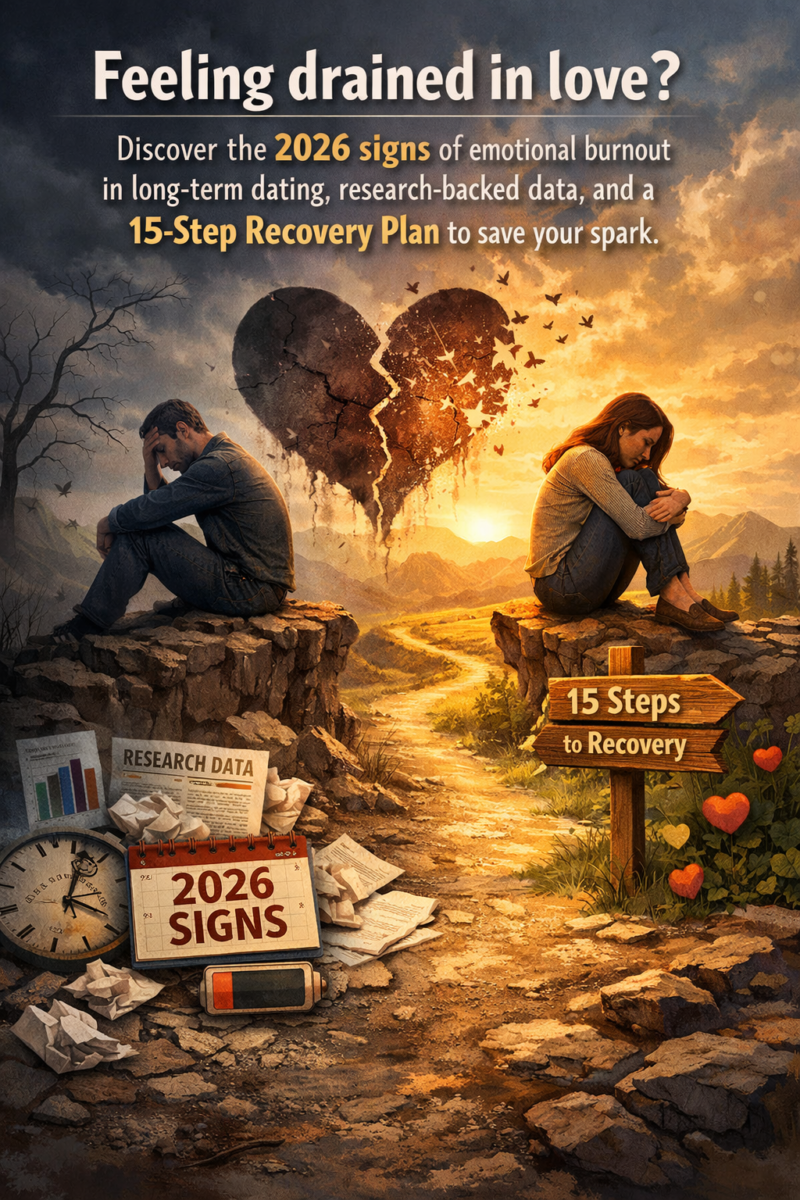
Smart To-Do List: 15 Steps to Recover from Relationship Burnout
Your 2026 Relationship Recovery Roadmap
- ✅ Identify the Leak: Write down the top 3 things that drain you in the relationship.
- ✅ Schedule “Solo-Sabbaths”: Spend 4 hours a week completely away from your partner.
- ✅ The 15-Minute Rule: Limit “heavy” relationship talks to 15 minutes a day.
- ✅ Externalize the Problem: Remind yourself: “It’s us vs. the burnout,” not “Me vs. You.”
- ✅ Prioritize Sleep: Physical exhaustion mimics emotional burnout.
- ✅ Practice Radical Honesty: Tell your partner, “I love you, but I am emotionally exhausted.”
- ✅ Lower the Bar: It’s okay if the house is messy or you eat takeout for a week.
- ✅ Digital Fast: Put phones away after 8 PM to stop “parallel scrolling.”
- ✅ Reconnect with Old Friends: Reclaim the version of you that existed before the relationship.
- ✅ Professional Audit: Consider a few sessions of relationship coaching.
- ✅ Physical Touch (Low Pressure): Hold hands without the expectation of sex.
- ✅ The “Thank You” Habit: Acknowledge one small thing they did right today.
- ✅ Revisit Your ‘Why’: Look at old photos from the “honeymoon phase.”
- ✅ Set Financial Boundaries: If money is the stressor, create a 2026 budget plan.
- ✅ Plan a “No-Talk” Activity: Go to a movie or a concert where talking isn’t required.
—
Natural Ways to Rejuvenate Your Emotional Energy
You don’t always need a grand vacation. Sometimes, micro-interventions work best. Practicing vagus nerve stimulation through deep breathing can physically lower the “threat” level your brain feels when your partner enters the room.
Additionally, focus on “Neurowellness.” Supplementing with Magnesium (after consulting a doctor) and ensuring Vitamin D levels are optimal can significantly improve your resilience to emotional stress.
-
Emotional exhaustion doesn’t happen overnight; it’s a slow burn that eventually leaves you feeling hollow inside.
-
When the effort to “stay happy” becomes a full-time job, you are no longer in a relationship—you are in a survival mission.
-
In 2026, the constant pressure to have a “picture-perfect” relationship on social media is a leading cause of dating burnout.
-
Real intimacy requires energy, but when you’re burned out, even a simple “How was your day?” feels like an interrogation.
-
A major red flag is when you start feeling more relaxed and “yourself” when your partner is not in the room.
-
Burnout turns the person you love into a source of stress, creating a painful cycle of guilt and isolation.
-
The silence between a burned-out couple isn’t peaceful; it is heavy with the weight of unsaid words and unresolved fatigue.
-
We often ignore the signs, calling it “just a phase,” until the emotional battery is completely dead.
-
Healing begins the moment you stop blaming yourself for being tired and start acknowledging the imbalance of emotional labor.
-
Relationships should be a place where you recharge, not where you spend your last bit of mental energy.
-
Many people confuse “fighting for the relationship” with “fighting against their own mental health.”
-
Burnout is the heart’s way of saying it has been carrying more than its fair share for too long.
-
Setting boundaries isn’t about pushing your partner away; it’s about protecting the space where love can actually breathe.
-
Chronic stress in dating can lead to physical symptoms like headaches, insomnia, and a weakened immune system.
-
Recovery is possible only when both partners agree to stop “performing” and start being radically honest about their capacity.
-
Taking a break to focus on individual mental health is often the bravest thing a couple can do to save their future.
-
A healthy relationship is a marathon, but you cannot finish it if you are running with a heavy backpack of resentment.
-
Digital age dating has made us “connected” 24/7, leaving zero room for the essential “me-time” that prevents burnout.
-
Rebuilding trust after burnout requires patience, as the mind needs time to feel “safe” enough to be vulnerable again.
-
Remember, a burnt-out version of you cannot provide the love that your partner—or you—truly deserves.
FAQ: Common Concerns about Emotional Burnout
Can a relationship survive emotional burnout?
Absolutely. Think of burnout like a forest fire; it looks devastating, but the soil underneath can become incredibly fertile for new, healthier growth if handled correctly.
How long does it take to recover?
Recovery usually takes 3 to 6 months of consistent boundary-setting and self-care. It is not an overnight fix.
Should I tell my partner I’m burned out?
Yes. Silence breeds resentment. Using “I” statements like “I feel overwhelmed by our current routine” is much more effective than “You are draining me.”
—
Final Thought: Your heart is a finite resource. If you don’t refill the tank, you can’t drive the distance. Emotional burnout in long-term dating isn’t the end of the road—it’s a sign that you need to change the tires and maybe find a better map for the journey ahead.
For more insights on future-proofing your love life, check out our guide on the link between gut health and emotional stability.