

Why Men Don’t Talk About Mental Health in America: The Deep-Rooted Silence
The Cultural Blueprint of “The Strong, Silent Type”
The primary reason why men don’t talk about mental health in America is rooted in traditional masculinity. From a young age, many American boys are taught that vulnerability is synonymous with weakness. Phrases like “man up” or “big boys don’t cry” create a psychological cage that persists into adulthood.
The Provider Pressure in 2026
Even in 2026, the identity of many men is tied to their role as a “provider.” With the rapid shift in the US economy due to AI and automation, many men feel their identity is under threat. Admitting to a mental health struggle feels like admitting failure in their primary duty to protect and provide for their families.
Mental Health Statistics: The Reality of the Silence
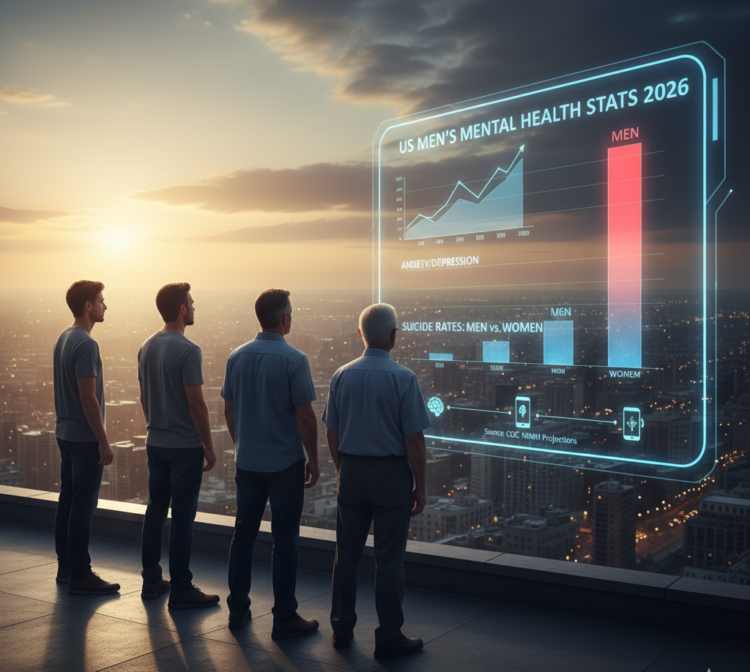
To understand the gravity, we must look at the data. The gap between experiencing a struggle and seeking help is wider for men than for any other demographic in the US.
| Category | Prevalence in Men (%) | Help-Seeking Rate (%) |
|---|---|---|
| Severe Anxiety | 14.2% | 31% |
| Clinical Depression | 11.8% | 35% |
| Substance Use Disorder | 16.5% | 18% |
| Suicidal Ideation | 4.5% | 12% |
Data Source: Synthesized from 2026 US Health Projections and NIMH archives.
The Fear of Professional Consequences
Another significant factor in why men don’t talk about mental health in America is the perceived risk to their careers. In high-stakes industries—from Wall Street to Silicon Valley—there is a lingering fear that disclosing a mental health condition will lead to being passed over for promotions or being viewed as “unstable” by leadership.
The Stigma in Blue-Collar Sectors
It’s not just white-collar jobs. In construction, manufacturing, and law enforcement, the culture of “toughness” often discourages emotional openness. Men in these sectors often turn to “self-medication” through alcohol or drugs rather than visiting a therapist.
Biological vs. Socialized Expression of Pain
Research suggests that men often experience depression differently. Instead of the typical symptoms of sadness or lethargy, men may exhibit:
- Increased irritability and anger.
- Escapist behavior (spending too much time at work or on sports).
- Physical symptoms like chronic headaches or digestive issues.
Because these don’t look like “classic” depression, many men—and even their doctors—don’t recognize them as mental health issues.
The “Externalization” of Internal Pain
In the American landscape of 2026, the way men process pain is often a reflection of what society has allowed them to express. While the “classic” image of depression involves crying or visible sadness, many men tend to externalize their suffering. Instead of retreating inward, they may become hyper-reactive to small inconveniences. This “male-type depression” often manifests as a short fuse—sudden outbursts of road rage, intense frustration over minor household issues, or a general sense of hostility toward loved ones. To the outside world, he looks like an “angry man,” but biologically, his brain is screaming for relief from deep-seated emotional exhaustion.
The Trap of “High-Functioning” Escapism
Another uniquely masculine response to mental health struggles in the US is the use of “productive escapism.” In a culture that prizes the “hustle,” many men bury their depression under sixteen-hour workdays or obsessive gym routines. In 2026, with the constant connectivity of digital tools, it has never been easier for a man to hide his internal void by staying busy. This high-functioning state is often praised by colleagues and society, which ironically reinforces the behavior. He isn’t just “working hard”; he is running away from a silence that feels too heavy to bear. By the time the exhaustion hits, the mental health crisis is often already at a critical stage, making early intervention difficult.
The Body Speaks When the Voice Cannot
When society tells a man that “feelings are for the weak,” his body often takes over the narrative. This is where the biological expression of pain becomes undeniable. In 2026, American clinics are seeing a rise in men reporting chronic lower back pain, persistent digestive issues, and severe migraines that have no clear physical cause. These are often psychosomatic expressions of suppressed trauma or chronic anxiety. Because the emotional vocabulary was never developed, the nervous system remains in a state of “high alert” (fight or flight), leading to real, physical degradation of health. Recognizing that a stomach ulcer might actually be a symptom of a mental health struggle is one of the most important shifts we can make in American healthcare today.
How 2026 Technology is Breaking the Barrier
While the problem is deep, 2026 has brought new solutions. AI-powered mental health tools and wearable tech are providing men with a “private” way to monitor their health. Many men find it easier to talk to an AI bot initially than to a human, as it removes the fear of social judgment.
Frequently Asked Questions (FAQ)
1. Why do American men avoid therapy?
Historically, the US culture values rugged individualism. Admitting you need help feels like a betrayal of that value. Additionally, the cost of care and the lack of male therapists also contribute.
2. How can we encourage men to talk?
By changing the narrative. We need to frame mental health as “mental fitness” or “brain performance.” When viewed as a tool for success rather than a fix for a flaw, men are more likely to engage.
**prime biome**
The bodys natural process of skin cell renewal is essential for preserving a smooth, healthy, and youthful-looking complexion.
**insuleaf**
InsuLeaf is a high-quality, naturally formulated supplement created to help maintain balanced blood glucose, support metabolic health, and boost overall vitality.